
Blue Carbon Conservation Based on the Wisdom of Indigenous Papuan Women: Protecting the Future of the Environment Through a Local Culture-Based Approach
Environmental conservation has become one of the world’s primary priorities in addressing global climate change. One approach receiving significant global attention is blue carbon conservation, especially within coastal & mangrove ecosystems that possess a high capacity to absorb carbon emissions. As an archipelagic nation, Indonesia holds enormous potential for blue carbon conservation development, particularly in Papua, where vast & natural mangrove ecosystems remain preserved. Through an integrated social, cultural, & environmental approach, Blue Carbon Conservation Based on the Wisdom of Indigenous Papuan Women has emerged as a strategic solution to maintain ecosystem balance while improving the welfare of local communities.
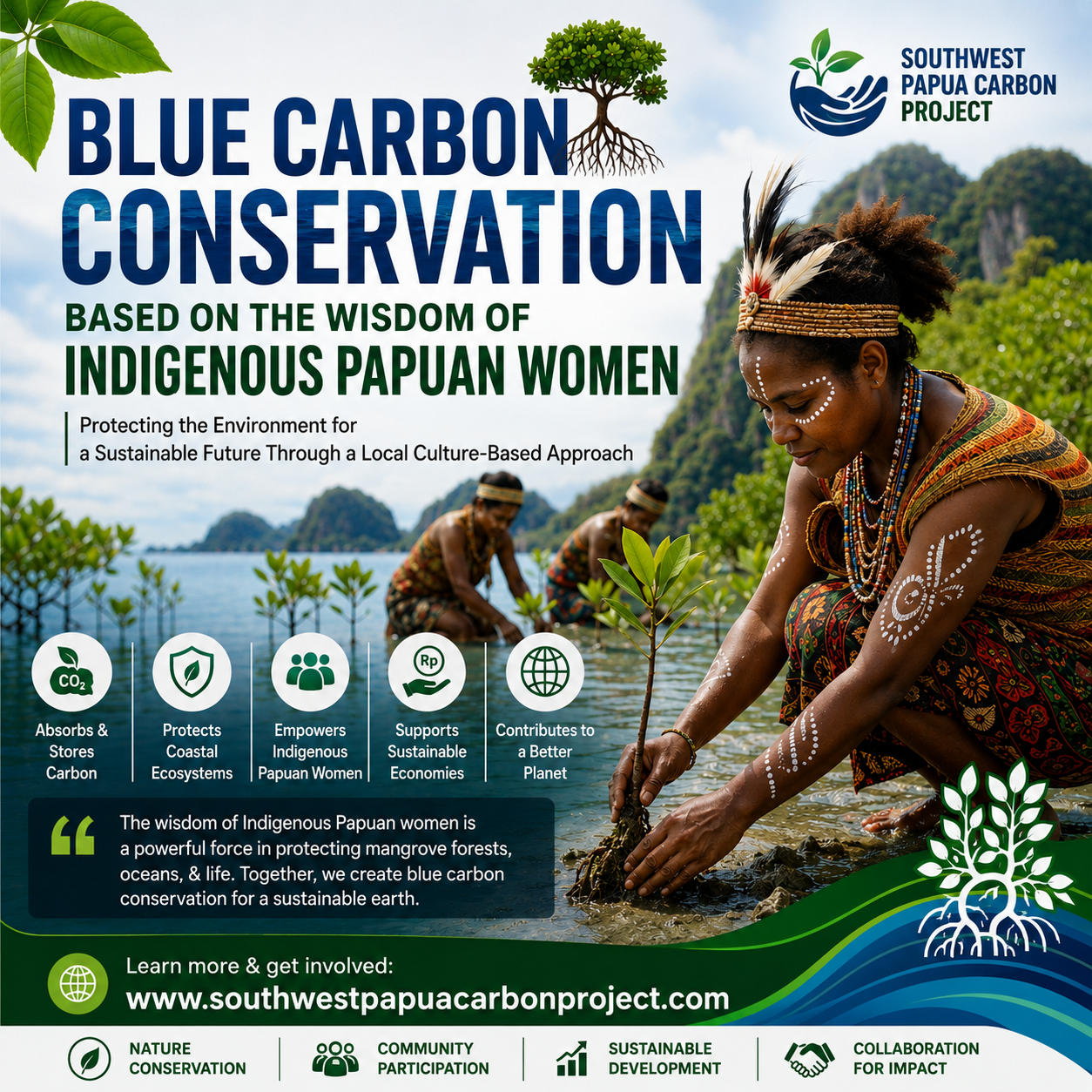
Climate change has significantly impacted coastal communities across Indonesia. Rising sea levels, coastal abrasion, extreme weather, & marine ecosystem degradation have become serious threats to community livelihoods. Under these conditions, mangroves & coastal ecosystems play a crucial role as natural barriers protecting coastal areas. Papua is recognized as one of the regions with the world’s largest blue carbon potential due to its extensive, natural, & community-protected mangrove forests. Therefore, the development of blue carbon conservation projects in Papua is not only an environmental protection initiative but also an essential part of the global sustainability strategy.
Also read articles : “The Potential of Mangrove Forests in Preserving Blue Carbon“
The Importance of Blue Carbon Conservation in Indonesia
As a provider of blue carbon conservation services & project assistance, we support various stakeholders in developing sustainable conservation programs based on indigenous communities while complying with international environmental standards. Our approach focuses not only on environmental preservation but also on respecting the cultural values & local knowledge inherited through generations of Indigenous Papuan women. By combining modern monitoring technology with traditional wisdom, conservation programs can operate more effectively, sustainably, & generate measurable impacts for both the environment & local communities.
Also read articles : “The Potential of Mangrove Forests in Preserving Blue Carbon“
Indonesia is considered one of the countries with the largest blue carbon potential in the world. Thousands of hectares of mangroves spread across coastal regions from Sumatra, Kalimantan, Sulawesi, to Papua. This potential places Indonesia at the center of global attention in blue carbon project development. Governments, international institutions, corporations, & environmental organizations are increasingly promoting coastal rehabilitation & protection programs to support global carbon emission reduction targets. However, successful conservation programs depend not only on technology or funding but also on the involvement of local communities as the primary guardians of coastal ecosystems.
Indigenous Papuan women have long maintained a close relationship with nature. They utilize mangrove forest resources wisely, preserve marine ecosystem balance, & implement customary regulations to prevent environmental degradation. This traditional knowledge forms an essential foundation for community-based blue carbon conservation. Through women-centered approaches, conservation projects can create a balance between environmental protection & improved quality of life for local communities.
What is Blue Carbon & Why Is It Important?
Papua possesses highly valuable coastal ecosystems that play a major role in sustaining global blue carbon reserves. In this context, understanding What is Blue Carbon becomes an important part of climate change mitigation efforts. Blue carbon refers to carbon stored within coastal ecosystems such as mangroves, seagrass meadows, & tidal wetlands. These ecosystems are capable of absorbing & storing massive amounts of carbon for hundreds to thousands of years. Papua’s mangrove forests represent one of Indonesia’s largest carbon storage potentials. Indigenous Papuan women continue to play a crucial role in protecting coastal ecosystems through customary laws, traditional natural resource management, & culturally based conservation practices. This women-centered conservation approach strengthens blue carbon initiatives both socially & environmentally.
Also read articles : “The Potential of Mangrove Forests in Preserving Blue Carbon“
Blue carbon ecosystems can absorb significantly more carbon than terrestrial forests. Mangroves, for example, store carbon not only within trees but also deep within coastal soils & sediments. As a result, protecting mangrove forests is one of the most effective strategies for reducing global carbon emissions.
Beyond carbon absorption, mangroves provide habitats for fish, crabs, shrimp, birds, & numerous marine organisms. Healthy coastal ecosystems help maintain marine food chains while supporting the livelihoods of fishing communities. Without mangrove protection, environmental degradation would intensify & directly impact coastal economies.
Also read articles : “The Potential of Mangrove Forests in Preserving Blue Carbon“
The Benefits of Blue Carbon in Coastal Ecosystems
In addition to mitigating climate change, blue carbon provides substantial benefits for human life & coastal ecosystem sustainability. Discussions surrounding The Benefits of Blue Carbon in Coastal Ecosystems have become increasingly important within environmental projects worldwide. Blue carbon helps improve water quality, prevent coastal erosion, provide habitats for marine species, & protect coastlines from storms & rising sea levels. Furthermore, mangrove ecosystems support local economies through fisheries, ecotourism, & sustainable non-timber forest products. We provide data-driven & community-based conservation assistance to ensure the benefits of blue carbon are maximized for local communities as well as environmental investors interested in sustainable projects in Papua.
Also read articles : “The Potential of Mangrove Forests in Preserving Blue Carbon“
Mangroves possess strong root systems capable of reducing wave impact & preventing coastal abrasion. In many coastal regions of Indonesia, mangrove destruction has accelerated shoreline erosion & increased flooding risks. By preserving mangroves, coastal communities gain natural protection against environmental disasters.
Blue carbon ecosystems also hold high economic value. Mangrove areas can be developed into conservation-based ecotourism destinations managed by local communities. In addition, blue carbon projects create opportunities for international carbon trading, generating economic benefits for indigenous communities & sustainability-focused stakeholders.
Also read articles : “The Potential of Mangrove Forests in Preserving Blue Carbon“
The Important Role of Blue Carbon for the Environment & Communities
In practice, the success of conservation projects is strongly influenced by indigenous community participation, especially women who preserve traditional ecological knowledge. Therefore, understanding The Important Role of Blue Carbon is essential for developing long-term conservation projects. Blue carbon not only contributes to carbon emission reduction but also strengthens social, economic, & cultural resilience in coastal communities. Indigenous Papuan women possess valuable knowledge regarding seasonal patterns, tidal cycles, mangrove utilization, & customary regulations protecting coastal ecosystems. We integrate participatory approaches into every conservation service to ensure communities become central actors in planning, management, & project monitoring. As a result, conservation initiatives deliver not only ecological success but also sustainable social impacts.
Also read articles : “The Potential of Mangrove Forests in Preserving Blue Carbon“
Blue carbon has become one of the most effective climate solutions because it delivers multiple benefits simultaneously. Beyond reducing emissions, conservation projects improve local economic resilience through environmental empowerment programs. This approach transforms conservation from purely an environmental agenda into a broader sustainable development strategy.
The involvement of Indigenous Papuan women adds significant value to conservation projects. Their local environmental knowledge helps create conservation strategies that are more effective & adapted to field conditions. Community-based participation also increases a sense of ownership, encouraging communities to actively protect conservation areas.
Also read articles : “The Potential of Mangrove Forests in Preserving Blue Carbon“
Sustainable Efforts to Preserve Blue Carbon
Today, the greatest threats to coastal ecosystems include overexploitation, land conversion, & lack of environmental awareness. Therefore, various Efforts to Preserve Blue Carbon are urgently needed in sustainable & measurable ways. Important actions include mangrove rehabilitation, coastal protection, strengthening customary regulations, empowering local women, & implementing technology-based carbon monitoring systems. We provide integrated conservation services ranging from site surveys, carbon project planning, carbon stock assessments, indigenous community engagement, to reporting aligned with national & international standards. Through collaborative approaches & extensive experience, we help develop conservation projects with strong environmental value while generating economic opportunities through blue carbon schemes.
Also read articles : “The Potential of Mangrove Forests in Preserving Blue Carbon“
Mangrove rehabilitation remains one of the most important steps in preserving blue carbon. Replanting damaged mangrove areas must be conducted carefully to ensure high success rates. Our field research-based approach ensures appropriate plant species selection according to local ecosystem conditions.
In addition to rehabilitation, continuous monitoring is essential for project success. The use of mapping technology, drones, & data-based reporting systems helps maintain regular ecosystem monitoring. This approach increases project transparency & credibility among investors as well as international environmental institutions.
Why Southwest Papua is a Strategic Location for Blue Carbon Conservation
Southwest Papua has become one of Indonesia’s most strategic regions for blue carbon conservation development. Many stakeholders seek to understand Why Southwest Papua is an Ideal Location for Blue Carbon Conservation because the region possesses natural mangrove ecosystems & exceptionally high biodiversity levels. In addition, indigenous communities in the region continue to uphold strong cultural values & customary regulations that preserve ecological balance. The combination of ecological richness & cultural strength makes Southwest Papua an ideal location for community-based blue carbon projects. We are ready to support corporations, organizations, governments, & communities in developing conservation programs tailored to Papua’s unique social & environmental characteristics. Our approach ensures long-term positive impacts for both ecosystems & local communities.
Southwest Papua contains extensive coastal areas with ecosystems that remain relatively intact compared to other regions in Indonesia. Many mangrove areas have experienced minimal environmental degradation, allowing them to maintain extremely high carbon storage potential. These conditions position Southwest Papua as a priority region for national & international blue carbon project development.
Beyond environmental factors, the existence of indigenous communities with strong conservation traditions further strengthens the importance of conservation projects in the region. Indigenous Papuan communities possess traditional regulations governing natural resource management, enabling them to preserve ecosystem balance for generations. Collaboration between traditional knowledge & modern technology creates substantial opportunities for successful blue carbon conservation initiatives.
Also read articles : “The Potential of Mangrove Forests in Preserving Blue Carbon“
Professional Community-Based Blue Carbon Conservation Services
As a professional blue carbon conservation service provider, we understand that project success depends not only on mangrove planting but also on strategic planning & community engagement. Therefore, we offer comprehensive solutions ranging from site potential identification, indigenous community social assessments, conservation strategy development, data-based monitoring, & environmental education programs. Our team consists of environmental experts, community facilitators, & local partners with deep understanding of Papua’s environmental conditions. Through modern technology & cultural approaches, we help create transparent, measurable, & sustainable conservation projects. Our services are also designed to support corporate ESG & sustainability programs with credible environmental impact.
We believe the best conservation initiatives must provide tangible benefits for both the environment & local communities. Therefore, all of our programs are designed through long-term collaboration strategies. We assist partners in project planning, blue carbon potential assessment, sustainability strategy development, & community education initiatives.
With extensive experience in environmental project development, we are ready to become a strategic partner for corporations, organizations, & communities with long-term sustainability visions. Our professional & culturally integrated approach ensures every project has a strong foundation for sustainable growth.
Tips for Joining Our Blue Carbon Conservation Projects
Joining our Blue Carbon Conservation Based on the Wisdom of Indigenous Papuan Women project represents a meaningful step toward environmental protection while supporting Indigenous Papuan communities. We welcome collaboration opportunities for corporations, investors, organizations, & individuals committed to environmental sustainability.
Through our projects, every contribution supports mangrove preservation, women’s empowerment, carbon emission reduction, & sustainable coastal economic development. With professional, transparent, & data-driven systems, our conservation programs are designed to create long-term environmental & social impacts.
Now is the time to become part of the climate change solution. Join us today & help create a greener, more sustainable future for generations to come.
Also read articles : “The Potential of Mangrove Forests in Preserving Blue Carbon“
Frequently Asked Questions (FAQ)
What is blue carbon?
Blue carbon refers to carbon absorbed & stored within coastal ecosystems such as mangroves, seagrass meadows, & tidal wetlands. These ecosystems have exceptional capacity to store carbon & reduce climate change impacts.
Why do Indigenous Papuan women play an important role in conservation?
Indigenous Papuan women possess traditional knowledge regarding natural resource management, seasonal patterns, & customary regulations inherited through generations, making them essential guardians of coastal ecosystem sustainability.
What are the benefits of blue carbon conservation for communities?
Blue carbon conservation protects coastal ecosystems, strengthens climate resilience, supports local economies through fisheries & ecotourism, & creates economic opportunities through sustainable carbon projects.
Can blue carbon projects provide economic benefits?
Yes. Blue carbon projects have strong economic potential through carbon trading, ecotourism development, community empowerment, & improved corporate sustainability value.
How can I join your conservation project?
You may join as a corporate partner, investor, community member, volunteer, or sustainability supporter. We provide various collaboration schemes tailored to project needs.
What services do you provide?
We provide blue carbon surveys, mangrove rehabilitation, monitoring & reporting, indigenous community assistance, project documentation, ESG consultation, & sustainability services.
Also read articles : “The Potential of Mangrove Forests in Preserving Blue Carbon“
Conclusion
Blue carbon conservation has become one of the most important solutions for addressing global climate change while preserving coastal ecosystem sustainability. Through cultural approaches & community participation, Blue Carbon Conservation Based on the Wisdom of Indigenous Papuan Women creates stronger environmental & social impacts. Indigenous Papuan women hold strategic roles in protecting coastal ecosystems through traditional knowledge & cultural values inherited for generations. With professional conservation support, blue carbon projects can be implemented more effectively, transparently, & sustainably. We are ready to become the best partner for organizations, corporations, communities, & stakeholders committed to building impactful blue carbon conservation programs for the environment, society, & the future of our planet.
Also read articles : “The Potential of Mangrove Forests in Preserving Blue Carbon“